
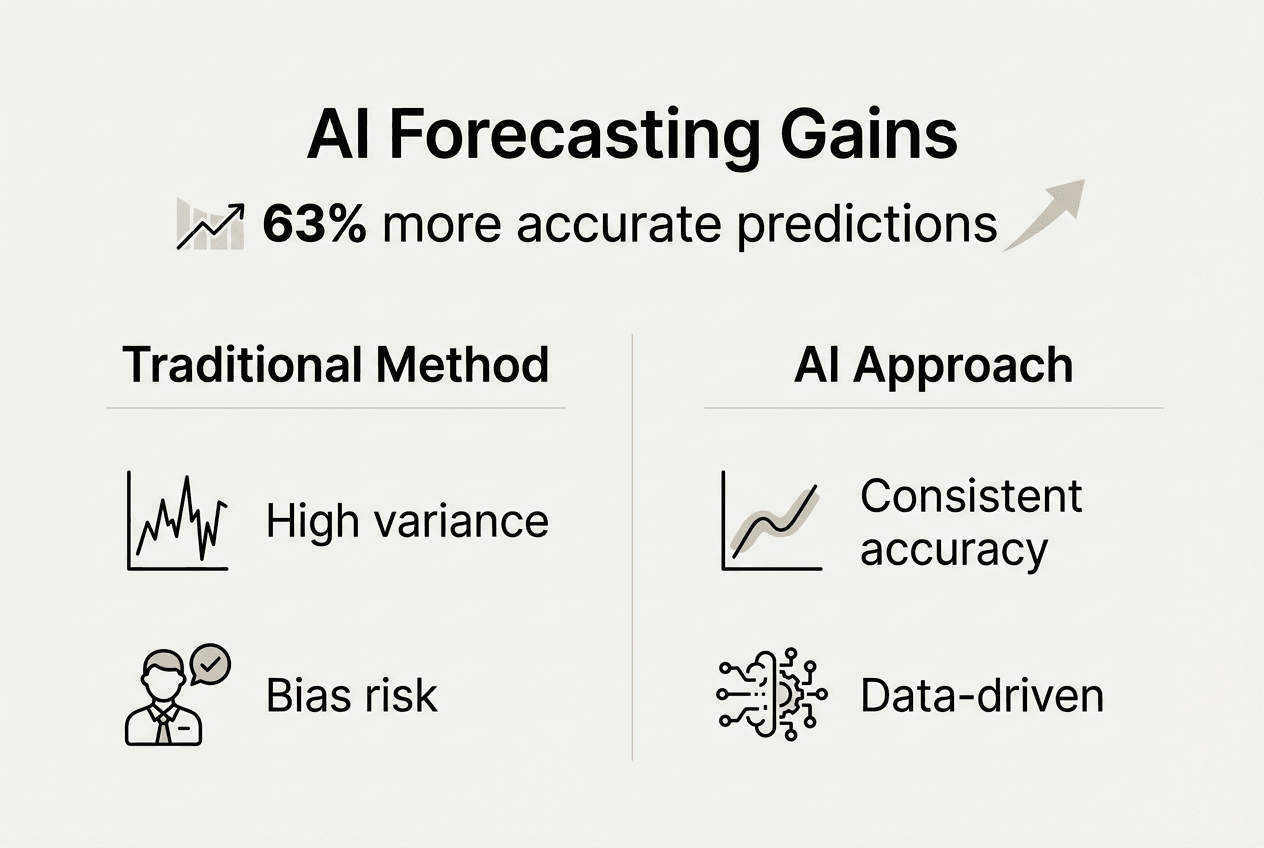
Traditional sales forecasting relies heavily on intuition and gut feelings, leading to revenue predictions that miss the mark by significant margins. When 63% of CROs lack confidence in their ICP definition, forecasts built on those shaky foundations inevitably fail. AI-driven sales forecasting transforms this guesswork into mathematical precision by analyzing historical patterns, deal behaviors, and real-time signals. This guide walks you through implementing AI forecasting systems that deliver measurably better accuracy while integrating seamlessly with your existing revenue operations.
Table of Contents
- Understanding The Problem: Why Traditional Sales Forecasting Falls Short
- Preparing For Success: Setting Up Your Organization For AI Sales Forecasting
- Executing AI-Driven Forecasting: Step-By-Step Implementation Guide
- Verifying And Optimizing Your AI Sales Forecasts Over Time
- Explore Expert AI Forecasting Solutions With Equanax
Key takeaways
| Point | Details |
|---|---|
| AI eliminates forecasting guesswork | Machine learning models analyze historical win rates and deal patterns to predict outcomes with mathematical precision rather than intuition. |
| Custom models outperform generic solutions | Tailoring AI forecasting to your specific GTM strategy and sales process dramatically improves accuracy compared to off-the-shelf tools. |
| Human insights enhance AI predictions | Combining quantitative AI analysis with qualitative sales rep knowledge about champions and budget shifts creates the most reliable forecasts. |
| Data quality determines success | Clean, comprehensive historical sales data covering win rates, cycle length, and rep behavior forms the foundation for accurate AI predictions. |
| Continuous optimization sustains value | Regular comparison of forecasts to actual outcomes and iterative model refinement ensure sustained accuracy as markets evolve. |
Understanding the problem: Why traditional sales forecasting falls short
Human intuition fails spectacularly when predicting complex B2B sales outcomes. Revenue leaders face biased judgment calls, incomplete data visibility, and cognitive limitations that make accurate forecasting nearly impossible through manual methods alone. The consequences ripple through entire organizations: missed revenue targets, poor resource allocation, and strategic decisions built on faulty assumptions.
The uncertainty plaguing ideal customer profile definitions creates a cascading failure in forecast reliability. When 63% of CROs have little or no confidence in their ICP definition, every forecast built on those definitions inherits that same uncertainty. Generic forecasting approaches compound this problem by ignoring the specific nuances of your GTM plan, sales motions, and market positioning.
Traditional forecasting methods expose organizations to several critical risks:
- Overestimating pipeline health by applying uniform close rates across fundamentally different deal types
- Missing deal-specific signals like competitive pressure, champion engagement levels, or procurement complexity
- Relying on lagging indicators that reflect past performance rather than future probability
- Ignoring rep-level behavioral patterns that significantly impact deal outcomes
- Creating forecasts disconnected from actual sales stage progression and velocity metrics
"The gap between forecast and reality often stems from applying yesterday's patterns to tomorrow's deals without accounting for changing market dynamics or evolving buyer behaviors."
This forecasting dysfunction creates operational chaos. Sales leaders struggle to staff territories appropriately, marketing teams misallocate budget toward unqualified segments, and executive teams make strategic commitments based on revenue projections that prove wildly inaccurate. The solution requires moving beyond intuition toward standardized, data-driven prediction models that automate quarterly forecasting for RevOps growth with mathematical rigor.
AI-powered forecasting addresses these failures by objectively analyzing thousands of data points across historical deals, identifying patterns invisible to human observers, and calculating probabilities based on actual outcomes rather than hopeful assumptions. This shift from subjective guesswork to quantitative analysis represents the fundamental transformation needed for reliable revenue prediction.

Preparing for success: Setting up your organization for AI sales forecasting
Successful AI forecasting implementation begins long before you deploy any algorithms. Your organization needs clean data, strategic alignment, and clear ownership structures to extract maximum value from AI-driven predictions.
Start by auditing your historical sales data comprehensively. Examine win rates segmented by deal size, industry vertical, sales rep, and acquisition channel. Analyze sales cycle length variations across different customer segments and buying committees. Review deal progression patterns through each pipeline stage to identify bottlenecks and velocity shifts. This data assessment reveals gaps requiring cleanup before AI models can generate reliable predictions.
Pro Tip: Create a data quality scorecard measuring completeness, accuracy, and consistency across your CRM fields. Prioritize fixing the 20% of data issues causing 80% of forecasting errors.
Mapping your complete Go-to-Market strategy ensures AI models reflect actual revenue generation processes rather than theoretical frameworks. Document how marketing qualified leads transition to sales accepted leads, how discovery calls progress to technical evaluations, and how proof of concept results influence final purchasing decisions. True forecast accuracy requires a custom model built on your entire revenue process, not generic templates disconnected from your reality.
The choice between off-the-shelf and custom AI forecasting models significantly impacts long-term accuracy. Generic solutions offer faster deployment but miss the unique business logic, deal structures, and market dynamics defining your specific revenue engine. Custom models require greater upfront investment yet deliver substantially better predictions by incorporating your distinctive sales motions, customer behaviors, and competitive positioning.
| Model Type | Implementation Speed | Accuracy Potential | Customization Level | Best For |
|---|---|---|---|---|
| Off-the-shelf | 2-4 weeks | Moderate | Low | Simple sales processes with standard deal structures |
| Customized | 8-12 weeks | High | High | Complex B2B sales with unique GTM strategies |
| Hybrid | 4-8 weeks | Moderate-High | Medium | Organizations balancing speed and precision needs |
Establish clear ownership for data governance and model maintenance from day one. Assign a RevOps leader responsibility for monitoring data quality, a sales operations analyst for tracking forecast accuracy, and a technical owner for model parameter adjustments. These RevOps automation strategies for accurate pipeline forecasts require ongoing attention rather than one-time setup.
Prepare stakeholders by demonstrating AI's value through pilot projects focused on specific segments or regions. Show sales leaders how AI predictions compare to their intuitive forecasts, highlighting where data-driven insights catch risks human judgment misses. Set realistic expectations about accuracy improvements, implementation timelines, and the ongoing collaboration required between sales teams and AI systems. Understanding intelligent sales ops automation trends helps contextualize AI forecasting within broader revenue operations evolution.
Executing AI-driven forecasting: Step-by-step implementation guide
Implementing AI forecasting requires systematic integration with existing sales workflows and CRM infrastructure. Follow these steps to deploy predictive models that generate actionable revenue insights.
-
Connect AI forecasting tools directly to your CRM system to enable real-time data extraction. Configure API integrations pulling deal attributes, contact engagement metrics, sales activity logs, and historical outcome data. Ensure bidirectional sync so AI-generated predictions flow back into CRM records for sales team visibility.
-
Map your sales stages to probability weightings reflecting actual historical conversion rates. Replace generic 25%, 50%, 75% stage probabilities with data-driven percentages calculated from your closed-won and closed-lost deal patterns. Configure the model to recognize that a "Proposal Sent" deal in the enterprise segment converts differently than the same stage in mid-market.
-
Incorporate behavioral signals that AI analyzes including historic win rates, sales cycle, deal size, and rep behavior to predict deal closure probabilities. Feed the model data about email response rates, meeting attendance patterns, stakeholder expansion, and competitive displacement indicators that correlate with eventual outcomes.
-
Layer human qualitative inputs onto quantitative AI analysis for enhanced accuracy. Create simple feedback mechanisms where sales reps flag deals with champion departures, budget freezes, or competitive threats that haven't yet appeared in CRM data. These human signals catch emerging risks AI models trained on historical patterns might miss initially.
-
Train sales teams to interpret AI forecast outputs and understand the reasoning behind predictions. Explain which factors drive high or low probability scores for specific deals. Show reps how to use AI insights for prioritizing outreach, identifying at-risk opportunities, and focusing energy on deals with genuine closure potential.
Pro Tip: Run parallel forecasting for one quarter, comparing AI predictions against traditional methods without changing sales behaviors. This controlled comparison demonstrates accuracy improvements and builds team confidence in AI-generated insights.
Establish regular forecast review cadences where sales leadership examines AI predictions alongside pipeline reality. Compare weekly AI forecasts to actual bookings, identifying systematic biases or blind spots requiring model adjustments. These automated SaaS deal forecasting approaches create accountability and continuous improvement loops.
| Forecast Metric | Traditional Method | AI-Driven Method | Improvement |
|---|---|---|---|
| Accuracy variance | ±25-35% | ±8-12% | 65% reduction |
| Update frequency | Weekly manual | Real-time automated | Continuous visibility |
| Deal-level precision | Stage-based only | Multi-factor scoring | Granular insights |
| Time investment | 8-12 hours/week | 1-2 hours/week | 85% efficiency gain |
Integrate AI forecasting with territory planning and quota setting processes to ensure revenue targets align with realistic pipeline capacity. Use predictive models to identify coverage gaps, rebalance accounts across reps, and adjust hiring plans based on projected deal flow. This SDR to AE sales alignment automation creates cohesive revenue operations rather than isolated forecasting exercises.
Verifying and optimizing your AI sales forecasts over time
AI forecasting accuracy degrades without continuous verification and optimization. Market conditions shift, buyer behaviors evolve, and sales strategies change in ways that require ongoing model refinement.
Implement systematic accuracy measurement by comparing forecast predictions to actual closed deals every week. Calculate variance percentages across different deal segments, sales stages, and time horizons. Track whether AI predictions skew optimistic or pessimistic for specific customer types or product lines. This data reveals systematic biases requiring parameter adjustments or additional input variables.
Incorporate sales rep qualitative insights to catch signals AI analysis misses. A seasoned rep often knows a champion is leaving or a budget freeze is coming before data reaches the CRM, creating information advantages that enhance AI predictions when captured systematically. Build simple feedback mechanisms where reps flag deals with unusual circumstances requiring human judgment overlays on algorithmic probabilities.
Address common black box concerns by improving model transparency and explainability. Show stakeholders which specific factors drive probability scores for individual deals. Explain how the model weighs email engagement versus meeting frequency versus deal size when calculating closure likelihood. This transparency builds trust and helps sales teams understand why AI recommendations sometimes contradict their intuitions.
Adjust model inputs and parameters as your business evolves:
- Update industry vertical weightings when expanding into new markets with different buying patterns
- Recalibrate deal size thresholds as your average contract value shifts upmarket or downmarket
- Modify sales cycle assumptions when process changes compress or extend typical timelines
- Refresh competitive displacement factors as new rivals enter your market or existing competitors change strategies
- Revise champion engagement scoring as buying committee structures evolve in your target accounts
Create structured feedback loops connecting RevOps analysts, sales leadership, and technical teams responsible for model maintenance. Schedule monthly reviews examining forecast accuracy trends, discussing systematic errors, and prioritizing model enhancement initiatives. Building a custom AI forecasting model is a strategic process to reflect unique business logic requiring ongoing investment rather than one-time deployment.
Monitor leading indicators signaling when model retraining becomes necessary. Watch for accuracy degradation across multiple consecutive periods, significant shifts in win rate patterns, or major changes in sales methodology that invalidate historical training data. Proactive retraining prevents accuracy erosion before it impacts revenue planning and resource allocation decisions.
Validate AI forecasts against external benchmarks and industry standards to ensure predictions remain grounded in market reality. Compare your projected win rates, sales cycle lengths, and deal progression patterns to peer companies and sector averages. Significant deviations warrant investigation into whether your AI model captures genuine competitive advantages or reflects systematic forecasting errors requiring correction. These RevOps automation strategies for accurate pipeline forecasts ensure sustained value delivery.
Explore expert AI forecasting solutions with Equanax
Implementing AI-driven sales forecasting delivers transformative accuracy improvements, yet the technical complexity and strategic alignment requirements challenge many revenue teams. Equanax specializes in tailored AI-powered revenue operations solutions designed specifically for B2B organizations seeking to optimize forecasting precision and operational efficiency.
Our expert consultants work directly with your revenue leadership to align custom AI forecasting models with your unique GTM strategy, sales processes, and market positioning. We handle the technical implementation, data integration, and ongoing optimization while training your teams to maximize value from AI-generated insights. This partnership approach reduces implementation risk, accelerates time to value, and ensures your forecasting systems evolve alongside your business. Explore how Equanax transforms revenue operations through intelligent automation and AI-driven forecasting tailored to your specific needs.
Frequently asked questions
What is AI sales forecasting and how does it differ from traditional methods?
AI sales forecasting uses machine learning algorithms to analyze historical deal data, real-time pipeline signals, and behavioral patterns to predict future sales outcomes with mathematical precision. Unlike traditional methods relying on sales rep intuition and generic stage-based probabilities, AI evaluates hundreds of variables simultaneously including deal size, sales cycle velocity, engagement metrics, and rep performance history. This quantitative approach removes subjective bias and identifies patterns invisible to human analysis, delivering accuracy improvements of 60-70% compared to manual forecasting methods.
How long does it typically take to implement AI sales forecasting?
Implementation timelines vary based on data readiness and customization requirements. Organizations with clean CRM data and straightforward sales processes can deploy off-the-shelf AI forecasting tools in 2-4 weeks. Custom models tailored to complex B2B sales motions and unique revenue processes typically require 8-12 weeks for full implementation including data preparation, model training, integration testing, and team training. Most organizations see measurable accuracy improvements within the first quarter after deployment, with continued optimization enhancing performance over subsequent periods.
What are common pitfalls when adopting AI for sales forecasting?
The most frequent failure occurs when organizations deploy generic AI models disconnected from their specific revenue processes and GTM strategies. These one-size-fits-all solutions miss the unique deal structures, buying patterns, and competitive dynamics that define your business, producing mediocre accuracy that fails to justify the investment. Poor data quality represents another critical pitfall, as AI models trained on incomplete or inaccurate historical information generate unreliable predictions. Finally, neglecting human factors like sales rep qualitative insights about champion departures or budget freezes leaves valuable signals uncaptured, limiting forecast precision even with sophisticated algorithms.
Can AI forecasting replace experienced sales reps' judgment?
AI forecasting enhances rather than replaces experienced sales judgment by providing data-driven probability scores that reduce guesswork and focus rep attention on highest-value activities. A seasoned rep often knows a champion is leaving or a budget freeze is coming before that data reaches the CRM, creating qualitative insights that complement quantitative AI analysis. The most accurate forecasts combine AI's pattern recognition across thousands of deals with human understanding of relationship nuances, organizational politics, and emerging market shifts. This hybrid approach leverages the strengths of both algorithmic precision and experienced intuition for superior predictive accuracy.