
AI adoption in marketing has exploded to over 90% in 2026, yet a striking confidence gap persists between leadership and frontline teams. While CMOs report strong faith in AI ROI, individual contributors remain skeptical about its practical value. This disconnect reveals a critical challenge: many B2B marketing leaders lack clarity on how AI technologies actually work, which applications deliver measurable results, and how to navigate governance hurdles. Understanding the distinction between generative and agentic AI systems, implementing effective governance frameworks, and measuring tangible outcomes are essential for transforming AI from buzzword to revenue driver. This article breaks down AI's real impact on sales automation and campaign optimization with evidence-based insights tailored for revenue operations professionals.
Table of Contents
- Current AI Adoption And Impact In B2B Marketing
- Understanding AI Technologies In Marketing: From Generative To Agentic Systems
- Challenges And Nuances Of AI In Marketing Operations
- Practical Steps To Implement And Scale AI For Marketing Success
- Enhance Your Marketing With Expert AI And Revops Consulting
- Frequently Asked Questions About AI In Marketing
Key takeaways
| Point | Details |
|---|---|
| Adoption surge | Marketing teams increased AI usage from 63% to 91% in just one year, leading all business functions. |
| Agentic systems deliver ROI | Autonomous AI reduces cost per acquisition by 30-40% while expanding campaign reach by 20-35%. |
| Governance is critical | Legal and compliance concerns jumped 3.4x as AI usage scaled, making frameworks essential for sustainable growth. |
| Confidence gap persists | 61% of CMOs trust AI ROI, but only 12% of individual contributors share that confidence. |
| Job satisfaction rises | 75% of marketers report AI increases their work satisfaction through automation of repetitive tasks. |
Current AI adoption and impact in B2B marketing
The marketing function has become the fastest-growing adopter of AI technologies across all business units. 91% of marketing teams now use AI, up sharply from 63% the previous year. This dramatic acceleration reflects AI's proven ability to automate content creation, personalize campaigns at scale, and optimize resource allocation in ways impossible through manual processes.
Marketing and sales departments lead this transformation because they generate massive volumes of repetitive work that AI handles exceptionally well. 65% of all companies use generative AI regularly in at least one business function, with marketing and sales recording the highest growth rates. These teams create hundreds of email variants, social posts, landing pages, and ad copies monthly. AI systems now generate these assets in minutes rather than days.
The operational efficiency gains translate directly to measurable business outcomes. Teams report significant improvements in campaign performance metrics, lead quality scores, and conversion rates. AI-powered personalization engines analyze customer behavior patterns and deliver tailored messaging that resonates with specific buyer personas. This precision targeting reduces wasted ad spend while increasing engagement rates across channels.
"Marketing teams using AI report cost savings of 25-40% on content production while simultaneously increasing output volume by 3-5x."
These efficiency improvements free marketing professionals to focus on strategic work rather than execution tasks. Campaign strategists spend more time analyzing market trends, developing positioning frameworks, and collaborating with sales teams on account-based strategies. The shift from tactical execution to strategic thinking explains why job satisfaction metrics have climbed alongside AI adoption rates.
B2B organizations particularly benefit from AI's ability to coordinate complex, multi-touch campaigns across email, social, paid search, and direct outreach channels. Sales ops automation trends show how AI integrates marketing and sales workflows to create seamless buyer journeys. The technology tracks prospect engagement across touchpoints and triggers appropriate follow-up actions based on behavioral signals.
Key adoption drivers include:
- Pressure to do more with smaller teams and tighter budgets
- Need for real-time campaign optimization across multiple channels
- Demand for personalized experiences at enterprise scale
- Competition from AI-native startups disrupting traditional markets
Understanding AI technologies in marketing: from generative to agentic systems
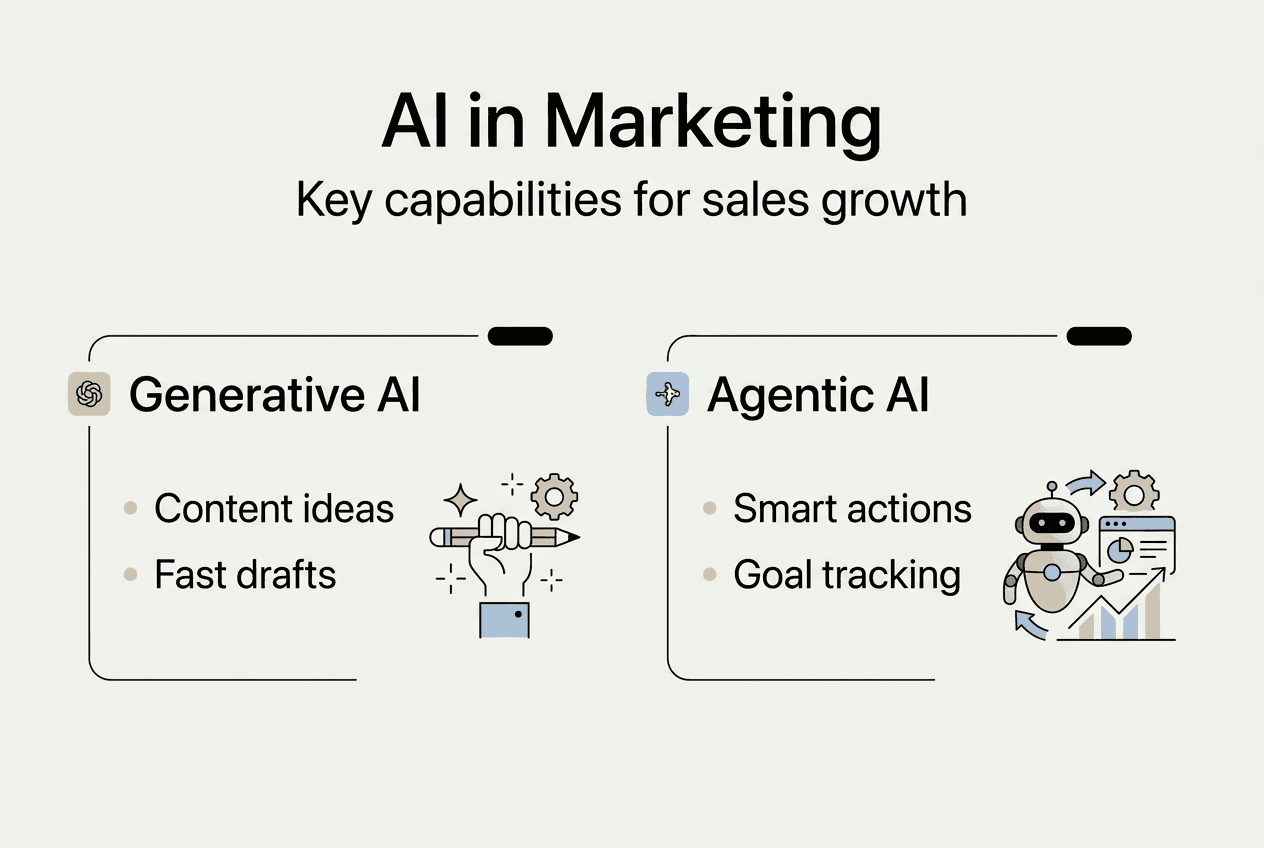
Marketing leaders often conflate different AI technologies under a single umbrella term, missing critical distinctions that determine use cases and outcomes. Generative AI creates new content based on patterns learned from training data. It produces blog posts, email copy, social media captions, and visual assets. These systems excel at high-volume content production but require human oversight for quality control and brand alignment.
Agentic AI represents a fundamentally different capability. These systems make autonomous decisions and take actions to achieve specified goals. An agentic marketing system monitors campaign performance metrics, analyzes competitor bidding strategies, evaluates audience response patterns, and automatically adjusts targeting parameters, budget allocations, and creative rotations. Agentic systems can reduce cost per acquisition by 30-40% while increasing campaign reach by 20-35%.

The distinction matters because these technologies solve different problems. Generative AI addresses content bottlenecks. Agentic AI optimizes decision-making at speeds and scales beyond human capacity. A B2B marketing team might use generative AI to create 50 email variants for an ABM campaign, then deploy agentic AI to determine which variants to send to which accounts based on firmographic data, engagement history, and real-time buying signals.
Agentic systems operate through continuous feedback loops. They set campaign objectives, monitor performance against targets, identify optimization opportunities, implement changes, measure results, and refine strategies. This cycle repeats thousands of times per day across multiple campaigns. Human marketers define guardrails and success metrics but the system executes tactical decisions autonomously.
| Capability | Generative AI | Agentic AI | | --- | --- | | Primary function | Content creation and variation | Autonomous decision-making and optimization | | Key applications | Email copy, social posts, ad creative, blog articles | Bid management, audience targeting, budget allocation, channel mix | | Human oversight | High (review and approval required) | Medium (monitoring and guardrail setting) | | Typical outcomes | 3-5x content output increase | 30-40% cost reduction, 20-35% reach expansion | | Implementation complexity | Low to medium | Medium to high |
Pro Tip: Combine generative and agentic AI for maximum impact. Use generative systems to create diverse creative assets, then deploy agentic systems to test, optimize, and scale the highest-performing variants across channels. This integrated approach delivered 2-3x better results than using either technology alone in recent B2B campaigns.
The technical architecture supporting agentic marketing systems integrates data from CRM platforms, marketing automation tools, advertising networks, and analytics systems. AI CRM automation integration enables these systems to access unified customer profiles and execute coordinated actions across the entire revenue tech stack. This integration creates closed-loop systems where marketing actions inform sales outreach, which feeds back into campaign optimization.
Agentic AI particularly excels in scenarios requiring rapid response to changing conditions. When a competitor launches a new product, the system detects shifts in search volumes and bidding patterns, then automatically adjusts messaging and targeting to address the competitive threat. When a prospect shows high-intent signals like pricing page visits or demo requests, the system triggers coordinated sequences across email, retargeting ads, and sales alerts.
Challenges and nuances of AI in marketing operations
Governance emerges as the dominant constraint preventing marketing teams from scaling AI effectively. As usage expands beyond pilot projects into production workflows, organizations confront questions about approval processes, quality standards, brand consistency, and compliance requirements. Concerns related to legal and compliance increased 3.4x year over year as AI-generated content volumes surged.
The governance challenge stems from AI's speed and scale. A single marketer using generative AI can produce more content in a week than an entire team previously created in a month. Without proper review mechanisms, off-brand messaging, factual errors, or compliance violations can reach customers before anyone catches them. Traditional approval workflows designed for manual content creation become bottlenecks that negate AI's efficiency advantages.
Brand consistency presents particular difficulties. AI systems trained on public internet data often produce generic, commoditized content that lacks distinctive voice and perspective. Marketing leaders struggle to maintain brand differentiation when AI-generated assets sound similar to competitor content. Developing custom models trained on proprietary brand guidelines and high-performing historical content requires significant investment and technical expertise.
A striking confidence gap separates leadership perspectives from frontline experiences. 61% of CMOs report confidence in AI ROI, while only 12% of individual contributors share that confidence. This disconnect creates organizational friction. Executives push for aggressive AI adoption while team members resist tools they view as unproven or threatening to their roles.
"The confidence gap reflects different vantage points: leaders see aggregate efficiency metrics and cost savings, while individual contributors experience workflow disruption, quality concerns, and pressure to learn new systems."
Legal teams raise valid concerns about copyright, data privacy, and regulatory compliance. AI systems trained on copyrighted content may generate outputs that infringe intellectual property rights. Marketing automation that processes personal data must comply with GDPR, CCPA, and industry-specific regulations. These legal considerations require cross-functional collaboration between marketing, legal, and IT teams to establish appropriate safeguards.
Successful AI governance balances control with agility. Overly restrictive processes eliminate AI's speed advantages. Insufficient oversight creates unacceptable risks. Leading organizations implement tiered approval frameworks:
- Low-risk content (social media posts, blog articles) receives automated review and publication
- Medium-risk assets (email campaigns, landing pages) require peer review before deployment
- High-risk materials (executive communications, regulatory filings) undergo traditional approval chains
Pro Tip: Create AI usage guidelines that specify approved tools, required review processes, and escalation paths for different content types and channels. Document these standards in a centralized repository accessible to all marketing team members. Schedule quarterly reviews to update guidelines based on new learnings and evolving risks. This structured approach builds confidence across organizational levels while enabling responsible scaling.
RevOps automation insights demonstrate how cross-functional governance frameworks align marketing, sales, and operations teams around shared AI standards. When all revenue functions follow consistent data handling, quality assurance, and approval protocols, AI systems operate more effectively across the entire customer journey.
The confidence gap narrows when organizations invest in change management alongside technology deployment. Training programs that demonstrate AI's practical benefits, address job security concerns, and develop new skills help frontline marketers become advocates rather than resisters. Transparency about AI's limitations and appropriate use cases builds realistic expectations.
Practical steps to implement and scale AI for marketing success
Successful AI implementation follows a structured approach that balances ambition with pragmatism. Organizations that achieve strong ROI start with focused pilots, measure results rigorously, and scale systematically based on evidence.
-
Assess current state and identify high-impact opportunities. Map existing marketing workflows to identify repetitive, time-consuming tasks suitable for automation. Prioritize use cases with clear success metrics, manageable scope, and strong business value. Content creation, email personalization, and campaign optimization typically deliver quick wins.
-
Select technologies aligned with specific needs and existing infrastructure. Evaluate AI platforms based on integration capabilities with current martech stack, ease of use for team skill levels, vendor support quality, and total cost of ownership. Avoid selecting tools based solely on feature lists without considering implementation requirements.
-
Launch focused pilot programs with defined success criteria. Start with one or two high-priority use cases rather than attempting organization-wide transformation. Set specific targets for efficiency gains, cost savings, or performance improvements. Establish measurement frameworks before deployment to track progress objectively.
-
Measure ROI using standardized metrics and attribution models. Track both efficiency metrics (time saved, cost per asset) and effectiveness metrics (engagement rates, conversion rates, revenue impact). 60% of teams tracking ROI report returns of at least 2x on their AI investment, but measurement discipline separates winners from strugglers.
-
Scale successful pilots while maintaining quality and governance standards. Expand proven use cases to additional teams, campaigns, and channels. Develop training programs to build organizational capability. Refine governance frameworks based on pilot learnings. Invest in custom models and integrations for strategic differentiators.
| Outcome Category | Metric | Typical Result | | --- | --- | | Cost efficiency | Content production cost per asset | 40-60% reduction | | Operational speed | Campaign launch time | 50-70% faster | | Campaign performance | Click-through rates | 15-25% improvement | | ROI multiple | Return on AI investment | 2-4x for mature programs | | Job satisfaction | Team member satisfaction scores | 75% report increases | | Reach expansion | Audience size at same budget | 20-35% growth |
Cross-functional collaboration between marketing, sales, and RevOps teams accelerates AI adoption and amplifies results. Marketing AI systems perform best when integrated with sales intelligence platforms, CRM databases, and revenue analytics tools. Sales ops efficiency automation creates unified workflows where marketing campaigns automatically trigger sales actions based on prospect engagement signals.
Data quality determines AI effectiveness more than algorithm sophistication. Systems trained on incomplete, outdated, or inconsistent data produce unreliable outputs. Invest in data hygiene initiatives before scaling AI deployment. Establish processes for continuous data validation, enrichment, and governance.
Pro Tip: Implement continuous optimization cycles where AI models receive updated training data monthly and performance metrics inform regular refinement. Solicit feedback from sales teams on lead quality, customer success teams on messaging resonance, and marketing teams on workflow efficiency. Use these inputs to adjust model parameters, retrain algorithms, and improve integration points. Organizations that treat AI as a dynamic system requiring ongoing optimization achieve 2-3x better long-term results than those deploying static implementations.
The job satisfaction improvements warrant attention beyond morale considerations. 75% of marketers report AI increases their job satisfaction by eliminating tedious tasks and enabling focus on creative, strategic work. This satisfaction translates to better retention, stronger performance, and more innovative thinking. Teams freed from manual execution contribute higher-value ideas and insights.
Successful implementations also require realistic timelines. Pilot programs typically show results within 60-90 days. Scaling to full production deployment takes 6-12 months for most organizations. Enterprise-wide transformation spanning multiple functions and geographies extends to 18-24 months. Rushing deployment without adequate testing, training, and governance creates technical debt and organizational resistance.
Enhance your marketing with expert AI and RevOps consulting
Navigating AI implementation complexity requires specialized expertise in both technology and revenue operations. Equanax delivers tailored consulting services that help B2B marketing leaders deploy AI systems strategically, overcome governance challenges, and accelerate ROI realization. Our team combines deep technical knowledge with practical experience scaling AI across marketing, sales, and operations functions.
We design integrated solutions that connect marketing automation, sales intelligence, and revenue analytics into unified AI-powered systems. Our approach addresses the full implementation lifecycle from needs assessment and technology selection through pilot execution, measurement framework development, and production scaling. Partner with Equanax to transform manual marketing processes into autonomous, AI-driven revenue engines that deliver measurable business outcomes. Our clients typically achieve 2-4x ROI on AI investments within the first year while building sustainable competitive advantages through intelligent automation.
Frequently asked questions about AI in marketing
What distinguishes agentic AI from generative AI in marketing?
Generative AI creates new content like email copy, social posts, and ad creative based on learned patterns. Agentic AI makes autonomous decisions and takes actions to optimize campaigns, adjusting bids, targeting, and budget allocation without human intervention. Agentic systems analyze performance data and market conditions to achieve specified goals, while generative systems produce assets requiring human review.
How can marketers measure AI ROI effectively?
Track both efficiency metrics like cost per asset and time savings alongside effectiveness metrics including engagement rates, conversion rates, and revenue impact. Establish baseline performance before AI deployment, then measure improvements against those benchmarks. Successful teams implement attribution models that connect AI-driven activities to pipeline and revenue outcomes, enabling clear ROI calculation.
What are the main risks of AI misuse in marketing campaigns?
Brand inconsistency occurs when AI generates generic content lacking distinctive voice. Compliance violations happen if systems process personal data improperly or create misleading claims. Copyright infringement risks emerge from AI trained on protected content. Quality issues arise when outputs contain factual errors or inappropriate messaging, particularly without proper review processes.
How can teams improve frontline marketers' confidence in AI tools?
Provide hands-on training demonstrating practical benefits and appropriate use cases. Address job security concerns transparently by showing how AI eliminates tedious work rather than replacing roles. Share success metrics from pilot programs proving measurable value. Involve team members in tool selection and implementation planning to build ownership and reduce resistance.
Which marketing functions benefit most from AI automation?
Content creation and personalization deliver immediate efficiency gains through automated asset production. Campaign optimization shows strong ROI through autonomous bid management and targeting refinement. Lead scoring and routing improve sales efficiency by identifying high-intent prospects. Email marketing benefits from AI-powered subject line testing, send time optimization, and dynamic content insertion.